Why Drone Inspections for Chimneys?
Clear evidence where traditional inspection falls short
Why Drone Inspections for Chimneys?
Chimneys are among the most failure-prone elements of traditional buildings, yet they are also one of the hardest components to inspect safely and properly from ground level.
Their height, exposure and construction mean that many defects develop out of sight, particularly at crowns, flaunching, flashings and terminations. Ladders and binoculars provide limited information; scaffolding is often disproportionate at an early stage.
Drone-assisted chimney inspections allow us to examine these elements directly, safely and in context, providing clear evidence to support professional advice.
This portfolio focuses specifically on chimney inspection.
Roof coverings, roof details and drainage elements are addressed separately.
Common Chimney Defects Identified by Drone
1. Chimney Crown and Flaunching Failure
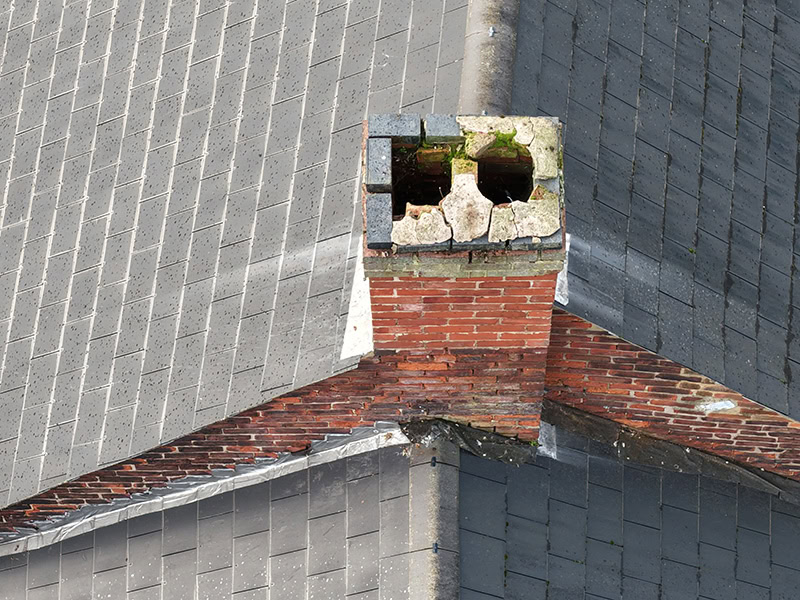
The chimney crown and flaunching are common points of failure and a frequent cause of water ingress, yet they are rarely visible from the ground.
Top-down drone inspection allows direct assessment of cracking, open joints and surface deterioration, supporting early and proportionate intervention.
2. Understand Chimney Arrangement and Interaction
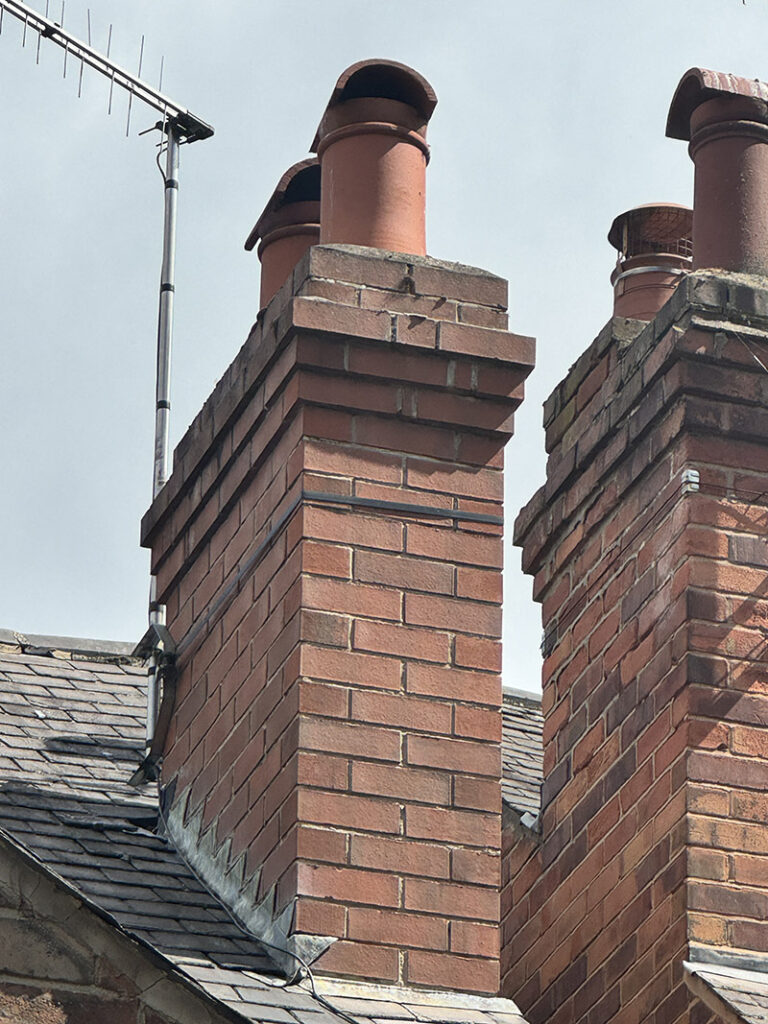
Where buildings incorporate multiple chimney stacks, defects often arise at shared interfaces and closely spaced junctions.
Drone inspection provides a clear understanding of how stacks relate to one another, reducing uncertainty and improving diagnosis.
3. Inspect Chimney Pots and Flue Terminations

Chimney pots and terminals are vulnerable to movement, cracking and deterioration, yet are difficult to assess safely by conventional means.
Aerial inspection allows alignment, fixing condition and termination detail to be reviewed without disturbance.
4. Examine Lead Flashings at Chimney Abutments

Lead flashings at chimney abutments are one of the most frequent sources of water ingress in traditional buildings.
Drone-assisted close inspection allows defects to be identified accurately without reliance on assumption or intrusive access.
5. View Chimneys in Full Elevational Context

Rather than isolating individual elements, drone inspections show chimney stacks in relation to surrounding roof slopes and elevations.
This contextual view supports a better understanding of exposure, weathering and performance over time.
6. Assess Larger and Multi-Flue Chimney Stacks
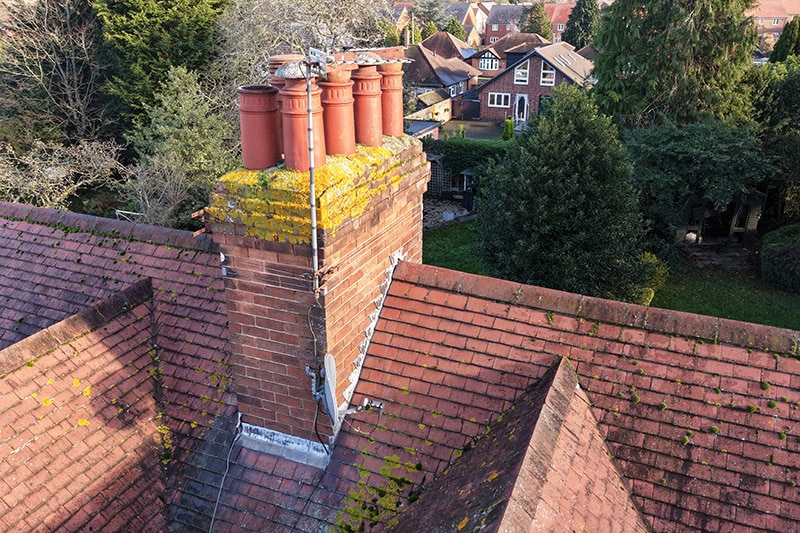
Larger chimney stacks often incorporate multiple flues, aerial fixings and historic adaptations that increase maintenance and safety risk.
Drone imagery captures these complexities clearly, supporting informed advice without intrusive access.
7. Understand Chimney Interfaces with Alterations

Alterations such as roof lights and extensions introduce new junctions around existing chimneys.
Drone inspection allows these interfaces to be assessed accurately, reducing reliance on incomplete visual checks.
8. Identify Moisture Retention and Biological Growth

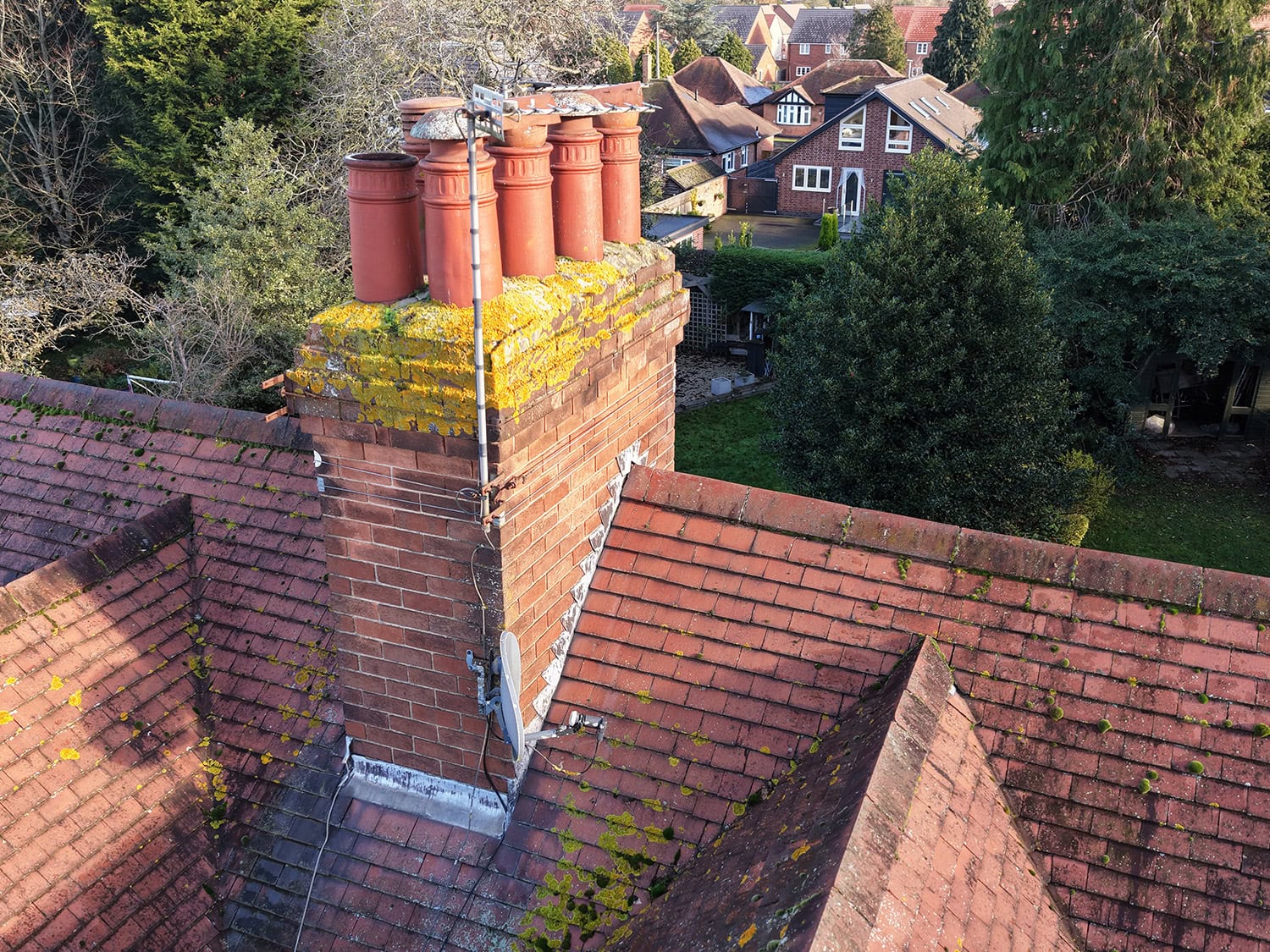
Top-down inspection reveals patterns of moss and lichen growth at chimney heads that indicate prolonged moisture retention.
This information assists in assessing deterioration risk and maintenance priorities.
9. Understand Chimney Exposure and Roof Geometry

Chimney performance is closely linked to roof geometry and exposure.
Aerial inspection allows this relationship to be understood clearly, supporting more reasoned advice.
Why Chimney Drone Inspections Matter
Chimneys deteriorate from the top down.
Many of the most serious defects develop above eye level, long before internal symptoms appear.
Drone-assisted inspections allow:
- Direct visual evidence of chimney defects
- Reduced reliance on assumption
- Safer inspection without ladders or scaffolding
- More proportionate and defensible recommendations
Used properly, drones do not replace professional judgement, they improve the quality of the evidence on which it is based.
How We Use Drone Inspections
Drone inspections are deployed selectively, where they add genuine value to chimney assessment, including:
- Residential surveys and defect investigations
- Historic and traditional buildings
- Difficult-to-access or high-risk chimneys
- Situations where scaffolding would be disproportionate
All findings are interpreted by a Chartered Surveyor as part of a wider professional assessment.
Roof coverings, roof details and drainage elements are addressed separately within our wider inspection services.
The Outcome
Clearer evidence.
Better understanding.
More confident decisions.